By Christopher Ling, CEO of Ericsson Federal Technologies Group
 Ericsson recently demonstrated a major breakthrough in Integrated Sensing and Communication (ISAC) at its U.S. headquarters in Plano, Texas. The event was a live proof of concept that showcased the power of next-generation networks not just to connect, but to sense the world around them. The demonstration – centered on drone detection using advanced massive MIMO radios – signals a transformative shift for wide-area sensing capabilities and offers compelling applications for the U.S. government and defense communities.
What Is ISAC and Why It Matters
ISAC is not your typical communications technology. It integrates sensing with communication networks, allowing systems on 5G and FutureG infrastructure to detect and characterize objects in the environment using the same radios and spectrum that carry data traffic. This capability extends network value well beyond connectivity into real-time spatial awareness, opening a new set of possibilities for both commercial and government missions.
In essence, ISAC transforms 5G and 6G networks from passive tools into active intelligence platforms, enabling the repurposing of commercial cellular networks into critical dual-use assets for applications like UAV air traffic control (commercial) and counter-UAV (military). This breaks new ground for scenarios where traditional sensors or standalone radar systems are limited by range, cost, or deployment footprint.
A Defense-Oriented Proof of Concept
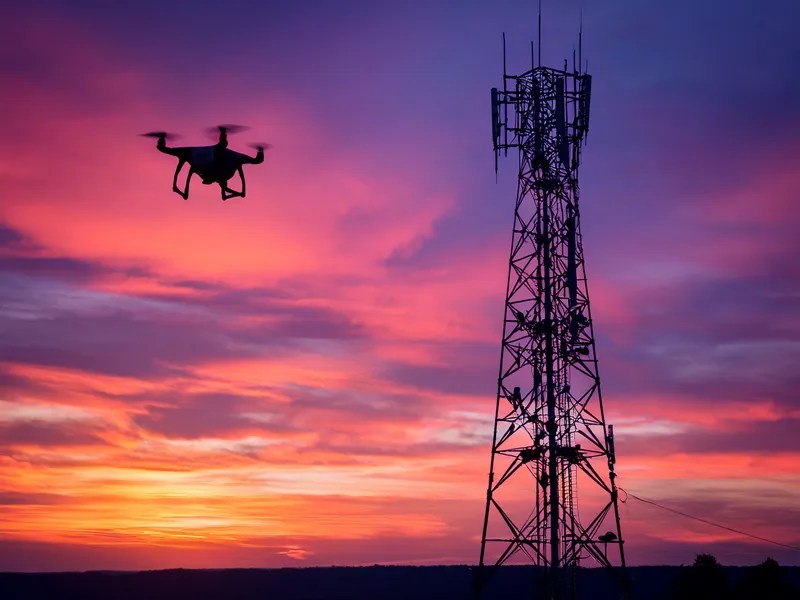
Recently, Ericsson’s engineers demonstrated how ISAC can detect unmanned aerial vehicles (UAVs) and track activity in surrounding airspace using existing cellular radios. This is far more than proof of concept. It shows that cellular infrastructure can contribute to national security and airspace awareness with minimal incremental hardware.
For US defense and DHS, this capability presents a layered sensing paradigm that augments local point sensors (like radar and optical systems) with wide-area network coverage. The result? Enhanced situational awareness to detect, localize, and track aerial threats in real-time without relying solely on specialized radar.
Advancing U.S. Government Engagement
Ericsson Federal is actively presenting ISAC capabilities to the Department of War, who has set this as a priority for counter-UAV sensing, to move beyond traditional defense. ISAC provides the innovative, scalable, and cost-effective technology that is necessary for command and control, integration with autonomous systems, and support for mission decision-making at scale.
Key defense-relevant benefits include:
- Enhanced Airspace Awareness – Detect and track UAVs and other aerial objects across a wide area using existing cellular networks.
- Persistent Situational Understanding – Networks that “see” as well as “connect” enhance battlespace awareness and command decision cycles.
- Augmented Sensor Networks – ISAC can complement and extend traditional sensors, enabling layered defense and resilient detection architectures critical to national security.
- Scalable Deployment – By reusing deployed network sites, spectrum, and radios, ISAC offers a pragmatic path to wide area sensing at scale.
These applications dovetail with defense modernization efforts that aim to unify communications, sensing, and AI-driven analytics for real-time decision support.
Why This Matters for America’s Tech Leadership
This successful proof of concept reinforces U.S. leadership in next-generation networking and sensing technologies. It also showcases how a secure, scalable ISAC foundation can drive economic growth while addressing critical defense and public safety needs.
As the technology continues to evolve toward 6G, and as standards bodies like 3GPP include ISAC capabilities in future releases, the opportunities for government and defense deployments will only expand. Ericsson Federal is committed to collaborating with U.S. agencies to ensure these innovations are responsibly fielded to enhance mission success.
For more on ISAC and its impact on defense and government applications, explore our ISAC use-case page or reach out to our team.