
The “G” in “5G” is short for “Generation”. 5G is the fifth generation of mobile communications networking that offers many strengths and capabilities. Its core capabilities include faster speeds (up to 100 times faster than 4G); ultra-low latency (as low as one millisecond to transmit); wider bandwidths (5G manages 1,000 times higher data volumes than 4G), and the capacity for a dense ecosystem of connected devices.

-
1 . The Foundation: Standalone Architecture and Core
-
2 . Deployment and Governance: Models and Standards
-
3 . The Technology Drivers: Spectrum and Performance
-
4 . Beyond 5G: The Vision for "Future G"
This section focuses on the core components that enable 5G’s most valuable and advanced capabilities.
-
5G Standalone (5G SA)
- Definition: 5G SA networks include a 5G RAN and a cloud-native 5G core. This is the true platform for mission-critical applications.
- Capabilities: It enables ultra-low latency, measured in milliseconds, supported by lower handover interruption time. 5G SA unlocks new 5G Voice over New Radio (VoNR) capabilities, allowing near-instant call connections, lower latency voice communications, and higher quality audio.
- Security: Enhanced end-to-end security is delivered through the 5G Core-integrated security module.
-
5G Non-Standalone (5G NSA)
- Definition: 5G NS is a 5G radio access network (RAN) that operates on a legacy 4G LTE core. It was a nascent, commercial stepping stone.
- Limitation: While offering faster speeds and enhanced mobile broadband experiences, it did not fully unlock advanced capabilities. The most valuable capabilities for government and defense use—ultra-low latency, guaranteed performance, and enhanced security—are inextricably linked to the 5G SA core.
-
Network Slicing
- Definition: The powerful capability of 5G SA that enables a single, physical network to be strategically partitioned into multiple, independent virtual networks.
- Customization: “Slices” are isolated from one another and can be customized through virtualization technologies for bandwidth, latency, reliability, and security.
- Benefits: It allows for Dedicated Performance, ensuring guaranteed Quality of Service (QoS) for mission-critical applications , and Secure Compartmentalization.
This section covers the strategic deployment choices, the architectural philosophy for open networks, and the global organization that defines 5G standards.
-
Public and Private 5G Networks
- Strategic Choice: For U.S. federal and defense audiences, the choice between public and private networks is a crucial strategic decision, directly affecting control, security, and mission readiness.
- Private 5G Network: Uses private RAN and core infrastructure, ensuring full operational control and isolation from public networks, providing secure, resilient connectivity.
- Public 5G Network: Utilizes commercial carrier infrastructure, offering broad geographic coverage and scalability, but may not necessarily meet strict federal security standards.
- Hybrid Networks: Combine Public 5G infrastructure with private core systems.
-
Open Radio Access Networks (O-RAN)
- Definition: An architectural approach to building Radio Access Networks (RANs) that unbundles and standardizes the hardware and software components of a network.
- Advantage: Unlike traditional RANs, O-RAN allows for components from multiple vendors to work together seamlessly.
-
Open Interfaces
- Definition: These interfaces, such as the O-RAN Alliance’s specifications combined with 3GPP-defined interfaces, facilitate interoperability between disaggregated RAN components.
-
3GPP (3rd Generation Partnership Project)
- Definition: An umbrella term for several standards organizations that develop protocols for mobile telecommunications.
- Role: The 3GPP defines many exciting use cases and applications enabled and enhanced through 5G Advanced.
This section details the technical elements that govern performance, deliver capacity, and enable specialized services.
-
5G Spectrum
- Definition: 5G’s dominant strength is its ability to operate across a broad range of radio frequencies.
- Low-Band (< 1 GHz): Provides the broadest geographic coverage at modest speeds (around 50 Mbps).
- Mid-Band (1 GHz – 6 GHz): Balances speed and coverage for 5G connectivity in suburban and urban environments.
- High-Band (mmWave, 24 GHz – 40+ GHz): Delivers the highest speeds, reaching up to 10 Gbps in controlled environments, but with limited range and high susceptibility to interference.
-
Enhanced Mobile Broadband (eMBB)
- Definition: One of three primary 5G New Radio (NR) use cases defined by the 3GPP.
- Impact: The improved data rates and throughput are critical for applications requiring the rapid transfer of large datasets , such as high-resolution video streaming, augmented reality (AR), and virtual reality (VR) operations.
-
Massive Machine Type Communications (mMTC)
- Definition: Addresses the need to support a large number of devices in a small area that may only send data sporadically , such as Internet of Things (IoT) use cases.
-
Massive MIMO (Multiple Input and Output)
- Definition: A wireless technology that multiplies the capacity of a radio link using multiple transmit and receive antennas.
- Impact: Massive MIMO more effectively exploits the spatial domain to improve the coverage, capacity, and user throughput of mobile networks. This is achieved by harnessing multi-antenna technologies, like beamforming and multiplexing.
-
Network APIs (Application Programming Interfaces)
- Definition: Standardized programming interfaces that allow developers to easily access 5G Advanced network capabilities , such as differentiated connectivity, location, security/authentication, and network insights.
While 5G deployment is still expanding, the industry has begun research and standardization for the sixth generation of wireless technology, “Future G”. Expected to be standardized by the late 2020s with commercial deployment around 2030, “Future G” is projected to be more than just a faster network; it will fundamentally change how networks are designed and operated.
Key Technological Leaps of “Future G”
- AI-Native, Cognitive Networks: 6G networks are envisioned as AI‑native, with AI/ML embedded in RAN, core, and management for closed-loop optimization, predictive resource allocation, and self-evolving behavior.
- Expansion into New Spectrum Ranges: 6G extends well beyond today’s mid-band and mmWave into upper‑mmWave, targeting 100+ Gbps peak throughputs with very high‑gain beamformed antennas.
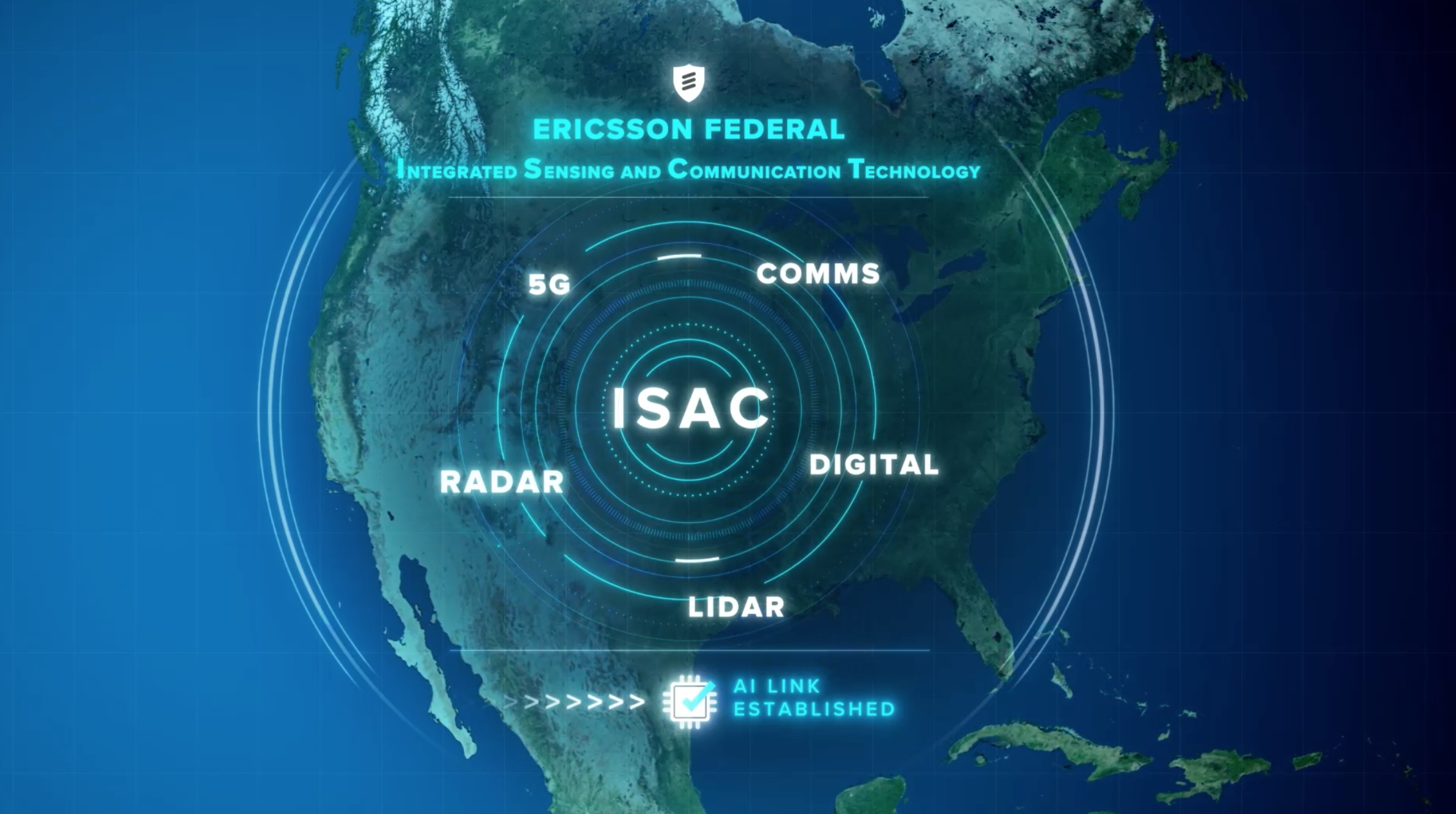
- Integrated Sensing and Communications (ISAC): 6G waveforms and RAN/core architecture are being designed to simultaneously provide connectivity and environmental sensing (e.g., localization, mapping, object detection) rather than treating sensing as an external system.
Send a STRONGER SIGNALTM
Learn how Ericsson Federal will help your mission succeed
Contact Us